
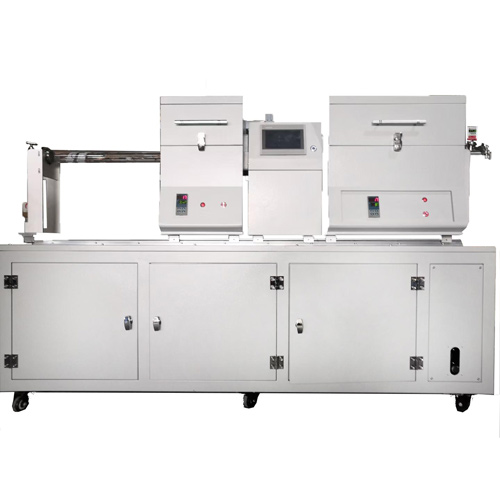
BTE-PECVD: Enhanced Plasma-Enhanced CVD System for Advanced Thin Film Growth
Overview
The BTE-PECVD is a state-of-the-art single-zone plasma-enhanced chemical vapor deposition (PECVD) system developed for high-precision, low-temperature thin film growth in research and industrial laboratories. Designed with an integrated RF power supply, heating system, multi-channel gas mixing unit, and vacuum control, this tube furnace-based PECVD system enables the synthesis of high-quality nanostructures such as nanowires, graphene, SiC films, and other functional materials under controlled plasma conditions.
Ideal for materials science, semiconductor research, and nanotechnology applications, the BTE-PECVD offers exceptional film uniformity, fast processing speed, and excellent process repeatability—making it a powerful tool for both academic exploration and pilot-scale production.
How It Works: Principle of PECVD
Unlike conventional thermal CVD, which relies solely on high temperature to activate chemical reactions, PECVD uses radio frequency (RF) plasma to generate reactive species at lower temperatures (typically 200–800°C). This allows:
- Lower deposition temperature: Enables processing of heat-sensitive substrates like polymers or flexible electronics.
- Higher deposition rate: Plasma enhances reaction kinetics, increasing film growth speed.
- Improved step coverage: Uniform deposition even on complex geometries.
In the BTE-PECVD system:
- Precursor gases (e.g., SiH₄, CH₄, NH₃) are introduced into the vacuum chamber.
- RF power (13.56 MHz) ionizes the gas mixture, creating a plasma rich in ions, radicals, and excited species.
- These reactive species deposit on the substrate surface, forming a thin film.
- The process is precisely controlled via temperature, pressure, gas flow, and RF power.
Key Applications
| Application | Material |
|---|---|
| Nanowire Synthesis | Si, ZnO, GaN, InP nanowires |
| Graphene Growth | CVD graphene on Cu/Ni foils |
| SiC Thin Films | Silicon carbide for high-power electronics |
| Dielectric Layers | SiO₂, Si₃N₄, Al₂O₃ for passivation |
| Carbon-Based Materials | Carbon nanotubes, diamond-like carbon (DLC) |
| Functional Coatings | Anti-reflective, anti-corrosion, hydrophobic layers |
✅ Note: The system supports both direct current (DC) and radio frequency (RF) plasma modes depending on configuration.
Technical Advantages
- ✅ Low-Temperature Operation: Enables deposition on temperature-sensitive substrates.
- ✅ Fast Heating/Cooling: Sliding furnace design allows rapid thermal cycling (<10 min).
- ✅ Uniform Deposition: Even gas distribution and stable plasma ensure consistent film quality.
- ✅ Multi-Gas Control: Up to 4 independent mass flow controllers (MFCs) for precise gas mixing.
- ✅ Smart Process Automation: Programmable gas injection, temperature ramping, and RF pulsing.
- ✅ Vacuum Compatibility: Operates from atmospheric pressure down to 5 Pa (high vacuum).
- ✅ Safety Features: Over-pressure protection, automatic shutdown, and emergency stop.
Product Specifications
| Modelo | Temperatura máxima (°C) | Furnace Size (mm) | Potencia total (kW) | RF Power | Gas Flow Meters | Vacuum System |
|---|---|---|---|---|---|---|
| BTE-PECVD1200-I | 1200 | 80×2000 | 4 | 300W | 3 channels | TRP-12, 3/s; Vacuum Measurement: 0.01Pa; System Vacuum: 5Pa |
| BTE-PECVD1200-II | 1200 | 80×2000 | 4 | 300W | 3 channels | Same as above |
| BTE-PECVD1200-III | 1200 | 80×2000 | 6 | 500W | 4 channels | Same as above |
📌 Custom configurations available for higher RF power, larger furnace size, or integration with other systems.
Intelligent Features
- Automated Gas Injection:
Supports intelligent gas pulsing based on preset temperature profiles — ideal for multi-step processes. - External Pressure Control:
Adjustable pressure settings (up to 200 kPa) allow optimization of plasma density and film morphology. - Data Logging & Cloud Storage:
All process parameters (temperature, pressure, gas flow, RF power) are recorded and accessible remotely. - Furnace Rotation Support (Optional):
Enhances uniformity during long-deposit cycles. - RF Source Integration:
Built-in 13.56 MHz RF generator ensures stable plasma ignition and minimal arcing. - Over-Pressure Protection:
Automatically shuts down if pressure exceeds user-defined limits.
Why Choose BTE-PECVD?
- ✔️ High Performance: Combines low-temperature processing with high deposition rates.
- ✔️ Versatile Platform: Suitable for graphene, nanowires, SiC, dielectrics, and more.
- ✔️ User-Friendly Interface: Intuitive touchscreen HMI with real-time monitoring.
- ✔️ Scalable Design: From lab-scale R&D to semi-industrial use.
- ✔️ Reliable & Safe: Robust construction with multiple safety interlocks.
Case Study: Graphene Growth on Copper Foil
A university research team used the BTE-PECVD1200-III to grow large-area graphene using methane (CH₄) and hydrogen (H₂) precursors. Results showed:
- High crystallinity confirmed by Raman spectroscopy
- Excellent sheet resistance (<1 kΩ/sq)
- Uniform coverage over 2-inch copper foil
- Processing time reduced by 30% compared to thermal CVD
This demonstrates how PECVD can offer faster, lower-cost alternatives to traditional methods.
Conclusion
The BTE-PECVD Enhanced PECVD System is a versatile, reliable, and high-performance solution for advanced thin-film deposition. With its combination of plasma activation, precise temperature control, and intelligent automation, it empowers researchers and engineers to explore new frontiers in nanomaterials, energy devices, and electronic components.
Whether you’re growing graphene, synthesizing nanowires, or developing next-generation semiconductors, the BTE-PCVD delivers precision, consistency, and scalability in every cycle.
📞 Contact Us Today for a technical consultation, demo, or custom configuration.
 Español
  English
  Deutsch
  한국어
한국어  Français
  Русский
  Bahasa Indonesia
  العربية
  Italiano