
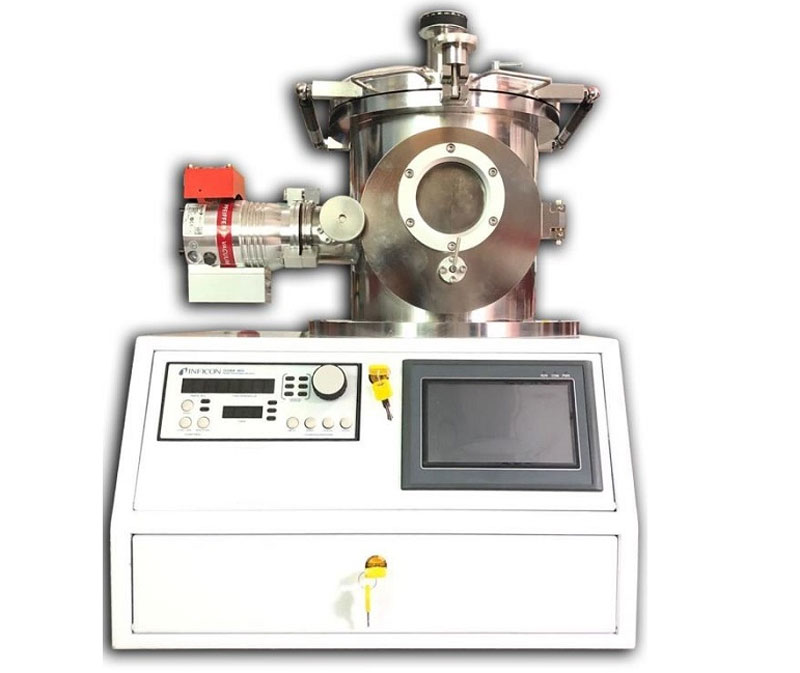
Resistance Evaporation Deposition System – Compact & Reliable Thin Film Coating Solution
Overview
The Resistance Evaporation Deposition System is a compact, high-performance thin film deposition instrument designed for laboratory-scale research and development in materials science, optoelectronics, and semiconductor applications. This system utilizes resistive heating to evaporate metal or organic materials in a controlled vacuum environment, enabling the deposition of high-purity, uniform thin films with excellent reproducibility.
Ideal for coating functional electrodes, transparent conductive layers, organic semiconductors, and nanomaterials, this system is widely used in OLED, OPV, perovskite solar cells, microelectronics, and surface engineering research.
With its small footprint, low power consumption, and user-friendly design, it is perfectly suited for installation in gloveboxes, fume hoods, or standard lab benches, making it an essential tool for academic and industrial R&D labs.
Características principales
- ✅ Compact Design:
Small size (L60×W60×H96 cm) allows placement in confined spaces such as gloveboxes or cleanroom benches. - ✅ Low Power Consumption:
Designed for energy efficiency—ideal for labs with limited electrical capacity. - ✅ High Stability & Reliability:
Uses imported or domestically optimized components (e.g., vacuum pumps, vacuum gauges) to ensure long-term stability and minimal downtime. - ✅ Smart Control System:
PLC + touchscreen intelligent control interface with automatic leak detection, fault alerts, and one-button vacuum shutdown for enhanced safety and ease of use. - ✅ Three-Temperature Zone Evaporation Source:
Supports evaporation of metals (Al, Ag, Au, Cu) and organic materials (PEDOT:PSS, MoO₃, etc.) using independent resistive heaters. - ✅ Vacuum Compatibility:
Achieves base pressure of 5×10⁻⁵ Pa (equivalent to 5×10⁻⁷ Torr) with mechanical + molecular pump configuration. - ✅ Film Thickness Monitoring:
Optional imported or domestic quartz crystal thickness monitor enables real-time monitoring and control of deposition rate and film thickness. - ✅ Rotatable Substrate Holder:
60×60 mm substrate holder with 0–20 rpm adjustable rotation speed, ensuring uniform coating on substrates up to 300°C. - ✅ Water Cooling System:
Integrated water-cooled copper boat and shield prevent overheating and improve material utilization.
Especificaciones técnicas
| Parameter | Specification |
|---|---|
| Material de la cámara | 1Cr18Ni9Ti stainless steel, welded structure, double sealing ring design |
| Tamaño de la cámara | Ø180 mm × 300 mm |
| Vacuum System | Mechanical pump + diffusion/molecular pump (domestic or imported optional) • Base pressure: 5×10⁻⁵ Pa • Pumping speed: 24 L/s • Vacuum gauge: Capacitance manometer (8×10⁻¹⁰ Pa range) • Valves: Electromagnetic valve + manual throttle valve |
| Evaporation System | Three-zone resistive evaporation sources • Water-cooled copper boats • 2 kW inverters with surge protection • Anti-spatter shield plate |
| Substrate Holder | Rotatable stage (60×60 mm), adjustable rotation speed: 0–20 rpm • Heating capability: up to 300°C • Option: angle-adjustable stage for oblique deposition |
| Thickness Monitor | Optional quartz crystal oscillator (in-situ monitoring of deposition rate and total thickness) |
| Sistema de control | PLC + touch screen intelligent control system • Automatic leak detection • Fault diagnosis and alarm • One-key vacuum stop |
| Dimensions (L×W×H) | 60 cm × 60 cm × 96 cm |
| Power Supply | 220V / 380V AC, 50Hz |
| Weight | ~80 kg |
| Interface | Pre-installed CF35 flange port for integration with other systems |
📌 Custom configurations available for larger chamber, multi-source setups, or integration with glovebox systems.
Aplicaciones
| Field | Application |
|---|---|
| Organic Electronics | Electrode deposition for OLED, OPV, and OFET devices |
| Photovoltaics | Transparent conductive oxide (TCO) layer coating, back contact formation |
| Semiconductors | Metal gate deposition, interconnect layers |
| Surface Engineering | Functional coatings for sensors, MEMS, and biomedical devices |
| Research & Development | Thin film growth for material characterization, device prototyping |
Why Choose Our Resistance Evaporation System?
- ✔️ Space-Saving Design: Fits easily into gloveboxes or small lab spaces.
- ✔️ High Precision & Reproducibility: Stable vacuum and temperature control ensure consistent results.
- ✔️ User-Friendly Operation: Touchscreen interface simplifies setup and monitoring.
- ✔️ Safety First: Built-in leak detection and automatic shutdown reduce risks.
- ✔️ Cost-Effective: Lower operating cost compared to electron beam or sputtering systems.
- ✔️ Flexible Configuration: Supports both metallic and organic materials.
Case Study: OLED Device Fabrication
A university research team used our resistance evaporation system to deposit Al cathodes and LiF buffer layers for OLED prototype fabrication. Results showed:
- Uniform film thickness across 2-inch glass substrates
- Excellent adhesion and low sheet resistance
- Reproducible performance across multiple batches
- Compatibility with glovebox operation for moisture-sensitive materials
This enabled rapid prototyping and optimization of device architecture without requiring large-scale equipment.
This case demonstrates how the system supports advanced optoelectronic research with minimal infrastructure investment.
Conclusion
The Resistance Evaporation Deposition System offers a compact, reliable, and high-performance solution for thin film deposition in academic and industrial laboratories. With its three-zone evaporation source, smart control system, and flexible configuration, it delivers excellent film quality and process consistency at an affordable cost.
Whether you’re developing next-generation solar cells, OLED displays, or functional coatings, this system provides the precision, flexibility, and reliability needed for successful R&D.
📞 Contact Us Today for a technical consultation, demo, or custom configuration.
 Español
  English
  Deutsch
  한국어
한국어  Français
  Русский
  Bahasa Indonesia
  العربية
  Italiano